How Account Aggregation Enhances Fintech Services in Digital Asset Trading and Online Investment Marketplaces
What Account Aggregation Actually Means in a Fintech Context
Most investors do not have one account. They have many - a brokerage, a crypto exchange, perhaps a robo-advisor, a pension fund, and a savings account sitting at a bank they joined a decade ago. Each platform shows its own slice of the picture. None of them show the whole thing. This structural fragmentation is not a quirk of user behavior; it is the natural result of a financial services industry that evolved product by product, institution by institution, without a shared view of the customer at its center.
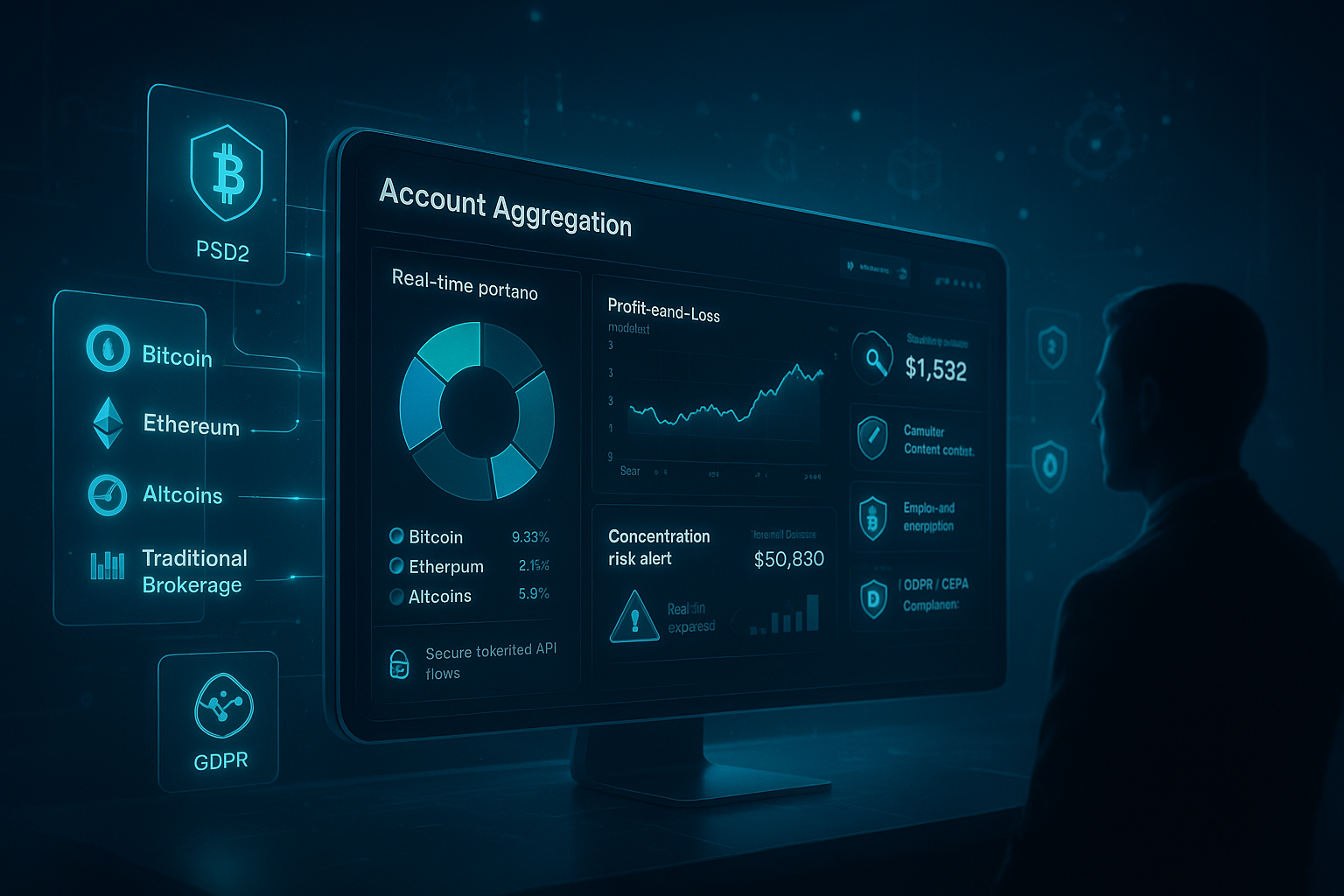
Account aggregation addresses this directly. At its core, it is a technology layer that collects financial data from multiple, separate accounts and presents it through a single unified interface - without moving any assets, without closing any accounts, and without requiring users to abandon the platforms they already use. For anyone operating across a financial marketplace that spans traditional investments, digital assets, and cash holdings, this unified view is not a luxury. It is a precondition for making rational decisions. Platforms that recognize this - including those in the acc marketplace space, such as accsmarket.com, where digital account access intersects with asset management workflows - are increasingly building aggregation into the core of their service architecture rather than treating it as an afterthought.
This article works through the mechanics, the benefits, the real limitations, and the practical selection criteria for account aggregation across digital asset trading, online investment platforms, and the broader fintech ecosystem. Whether you are an individual investor trying to see your portfolio clearly or a platform operator deciding whether to build or buy aggregation capabilities, the goal here is precision over generality.
Account aggregation in fintech relies primarily on three technical approaches. The most robust is API-based integration, where financial institutions expose standardized data endpoints that aggregators can query securely with explicit user authorization. The second is open banking, a regulatory framework - most formalized in the European Union's PSD2 directive and the UK's Open Banking Standard - that mandates API access as a right for customers, not a discretionary offering from banks. The third, and least stable, is screen scraping, where aggregation software logs into accounts using stored credentials and parses the displayed data. Screen scraping works where APIs do not exist, but it is fragile, security-sensitive, and increasingly being phased out as API coverage expands.
The distinction between aggregation and consolidation deserves emphasis because it changes how users should think about their data. Consolidation physically transfers assets into one place - a managed account, a wrapped product, a single custodian. Aggregation does none of that. Your Coinbase balance stays at Coinbase. Your brokerage account stays with your broker. The aggregation layer simply reads from all of them and presents a coherent composite. This means users retain the benefits of each specialized platform while gaining the visibility that those platforms individually cannot provide.
Three distinct groups benefit from well-implemented aggregation. End users gain clarity and decision-making context. Platform operators gain richer behavioral data that enables genuine personalization rather than demographic guesswork. Compliance and risk teams gain oversight across a user's full financial footprint, which is increasingly relevant as regulatory expectations around suitability assessments and anti-money laundering monitoring grow more demanding.
The Role of Account Aggregation in Digital Asset Trading
Digital asset markets are structurally different from traditional securities markets in one critical respect: there is no central exchange. Equity traders in most jurisdictions route orders through a regulated central venue. Crypto traders scatter their activity across dozens of competing exchanges, each with different liquidity profiles, fee structures, security histories, and supported assets. Add self-custody wallets and DeFi protocols into the picture, and a serious digital asset trader may hold positions across eight or ten separate environments simultaneously.
Without aggregation, managing this exposure is an exercise in manual reconciliation. With it, the picture changes entirely.
Unified Portfolio Visibility Across Multiple Exchanges and Wallets
The most immediate value of account aggregation for digital asset trading is the elimination of portfolio blind spots. A trader who holds Bitcoin on one exchange, Ethereum in a MetaMask wallet, and a range of altcoins on two other platforms cannot accurately assess their total exposure, their true profit and loss, or their asset allocation without pulling numbers from four separate sources and doing the arithmetic themselves.
Aggregation platforms that support major exchanges via read-only API keys - combined with blockchain address tracking for self-custody wallets - can consolidate this data into a single dashboard updated in near real time. The result is not just a convenience; it is a substantive improvement in decision quality. A trader who can see their complete holdings is better positioned to identify overconcentration in a single asset, spot rebalancing opportunities across venues, and make entry or exit decisions based on total position size rather than the partial view from a single platform.
- Real-time balance consolidation across centralized exchanges and self-custody wallets
- Unified profit and loss tracking that accounts for fees and transfers across platforms
- Cross-platform asset allocation breakdown to identify concentration risk
- Historical performance comparison across trading venues
Risk Management and Position Monitoring
Effective risk management depends on knowing your total exposure at any moment. In digital asset trading, where price swings of ten percent or more in a single day are common, the inability to see your full position in real time is not just inconvenient - it is genuinely dangerous from a portfolio management perspective.
Aggregation tools that compile cross-exchange data enable traders to set concentration thresholds and receive alerts when a single asset exceeds a defined percentage of their total portfolio. For leveraged positions across multiple platforms, the aggregate exposure can be far larger than any single platform shows, and only consolidated data makes that visible. Professional and institutional traders often connect aggregated data feeds into risk engines that model downside scenarios across the full portfolio - a workflow that is simply not possible when positions remain siloed across disconnected accounts.
Tax Reporting and Compliance Across Trading Accounts
Crypto tax compliance has developed a well-deserved reputation for complexity. Most jurisdictions that tax digital asset gains require transaction-level detail: acquisition dates, cost basis for each unit, proceeds from disposals, and accurate records of transfers between wallets and exchanges. A trader who has been active across multiple platforms for several years may be working with tens of thousands of individual transactions scattered across separate export files in incompatible formats.
Account aggregation consolidates this transaction history automatically. When integrated with dedicated crypto tax software, aggregated data can generate compliant tax reports without requiring users to manually reconcile spreadsheets or re-enter data. The practical time saving is significant. More importantly, the accuracy improvement reduces the risk of underreporting, which carries real legal and financial consequences in jurisdictions with active enforcement postures toward digital asset gains.
| Challenge Without Aggregation | Solution With Aggregation | Impact on Trader |
|---|---|---|
| Manual tracking across multiple exchanges | Unified real-time dashboard | Faster, more accurate decisions |
| Fragmented tax transaction records | Automated transaction compilation | Simplified compliance reporting |
| Hidden concentration risk across platforms | Cross-platform exposure monitoring | Improved portfolio risk management |
| Performance blind spots per venue | Consolidated profit and loss visualization | Clearer investment performance view |
How Online Investment Platforms Leverage Account Aggregation
For an online investment platform, the strategic case for incorporating account aggregation goes well beyond user experience polish. Platforms that aggregate data from outside their own walls gain something most of their competitors lack: full financial context on each user. That context transforms what the platform can do - from onboarding efficiency to the quality of investment recommendations to the strength of the retention argument it can make to users over time.
Personalized Financial Insights and Recommendations
Personalization has become a standard marketing promise across fintech, but most platforms deliver something more modest: recommendations based on the slice of a user's finances that live on that specific platform. If a user holds 20 percent of their net worth on a given platform and 80 percent elsewhere, recommendations calibrated only to that 20 percent are structurally incomplete and potentially counterproductive.
Account aggregation gives online investment platforms access to the full 100 percent. A platform that can see a user's external equity portfolio, their cash holdings at other institutions, and their existing digital asset exposure can offer recommendations that genuinely improve overall allocation rather than simply optimizing the in-platform slice. A user carrying excess cash in a low-yield savings account linked through aggregation might receive a specific, relevant suggestion to deploy that capital. A user whose aggregated external holdings reveal heavy concentration in a single sector might be offered diversification options that actually reduce their total portfolio risk. This is personalization that earns the word.
Streamlined Onboarding and Know Your Customer Processes
Onboarding friction is one of the most reliable predictors of user drop-off in fintech. The more steps, form fields, and document uploads required before a user can access the core product, the lower the completion rate. Account aggregation addresses this directly by replacing manual data entry with permissioned data retrieval.
When a new user authorizes an online investment platform to aggregate their existing financial accounts, the platform can pre-populate risk profile data based on actual asset holdings and behavioral history rather than self-reported questionnaire responses. Identity and income verification processes can draw on data already verified by linked institutions, reducing the documentation burden on the user. In regulated environments, this also supports more accurate suitability assessments - a compliance requirement in many jurisdictions that can otherwise create significant friction between onboarding and the first investment.
Cross-Platform Performance Benchmarking
A platform that aggregates a user's external accounts can offer something unusual in the fintech services landscape: objective, personalized benchmarking. Rather than comparing platform returns to a generic index, the platform can show users how their performance on this platform compares to their returns on every other platform in their aggregated view.
This level of transparency requires confidence in the product, and that confidence, when justified, converts directly into increased allocation. Users who can see concrete evidence that one platform consistently generates better outcomes than their other accounts have a rational basis for shifting assets toward it. Aggregation, in this framing, functions as a built-in competitive audit - one that benefits users with clarity and benefits the platform with credibility it could not manufacture through any other means.
Account Aggregation as Infrastructure for the Financial Marketplace
At the individual product level, account aggregation improves user experience and platform performance. At the systemic level, it is the connective tissue that allows a genuinely integrated financial marketplace to function. Without the ability to move data fluidly, securely, and with explicit user consent between institutions and services, fintech ecosystems remain a collection of disconnected tools rather than a coherent infrastructure for managing financial life.
Open Banking and API Ecosystems
The regulatory formalization of open banking has materially changed the economics and feasibility of account aggregation. Before PSD2 came into force in Europe, aggregation depended on bilateral agreements between individual institutions and aggregators - slow to negotiate, expensive to maintain, and inconsistent in data quality. PSD2 changed the model by mandating standardized API access as a customer right, not a commercial arrangement. Banks must provide third-party access when customers authorize it. The technical interface is standardized. The legal framework is defined.
For fintech services operating within these frameworks, the practical effect is a dramatically lower barrier to building aggregation features. Open banking APIs cover the majority of consumer banking relationships in the EU and UK. Comparable frameworks are developing at varying speeds in Australia, Brazil, Canada, and parts of Southeast Asia. In the United States, regulation has lagged, but the Consumer Financial Protection Bureau has moved toward formalizing open banking rules that would create similar access rights.
For financial marketplace operators, this trajectory matters strategically. Aggregation built on open banking APIs is more reliable, more legally defensible, and more scalable than aggregation built on bespoke integrations or screen scraping. The infrastructure is becoming standard, which means competitive differentiation will increasingly come from how well platforms use aggregated data rather than from the raw ability to aggregate it at all.
Data Security, Consent, and Privacy Considerations
Aggregating financial data across multiple institutions creates a concentrated data asset that requires proportionately serious security architecture. A breach affecting an aggregation platform does not expose one account - it potentially exposes everything a user has connected. This concentration risk is real, and it is the primary source of legitimate skepticism about aggregation from privacy-conscious users.
Responsible aggregation platforms address this through several specific mechanisms. Tokenized API credentials mean the aggregator never needs to store a user's actual login details - access is granted through a token that can be revoked without changing passwords. Granular consent controls allow users to specify exactly which accounts and data types are shared and for how long. Read-only API scopes ensure the aggregator can view data but cannot initiate transactions. End-to-end encryption protects data in transit and at rest.
- Tokenized access credentials that replace stored passwords
- Granular per-account consent controls with time limits
- Read-only API scopes that prohibit transaction initiation
- End-to-end encryption for data in transit and at rest
- User-accessible mechanisms to audit and revoke all data sharing
- Compliance with applicable frameworks including GDPR, CCPA, and PSD2
Platforms that treat consent as a checkbox rather than a genuine user control undermine the trust that makes aggregation useful. Users who do not trust the data-sharing model will not connect their accounts, and an aggregation feature no one uses has no value. Clear, accessible privacy communication is a functional requirement, not a regulatory formality.
Enabling Embedded Finance and Marketplace Expansion
One of the more consequential effects of widespread account aggregation infrastructure is the expansion it enables for embedded finance - the integration of financial products and services into non-financial platforms. When verified financial data can flow securely through APIs with user consent, it becomes technically and commercially viable for platforms outside the traditional finance sector to offer banking, investment, credit, and insurance services directly within their own interfaces.
An e-commerce platform with aggregated access to a buyer's financial data can offer point-of-sale credit more accurately than a standalone lender with no transaction history. A SaaS business tool with aggregated access to a company's accounts can surface cash flow insights and investment recommendations without requiring the user to leave the platform. These integrations expand the financial marketplace beyond its traditional boundaries - and account aggregation is what makes them safe and scalable rather than speculative.
Key Benefits of Account Aggregation for Fintech Services: A Comparative View
The value of account aggregation is not uniform across all participants in the fintech ecosystem. The same technology that gives a retail investor a cleaner view of their portfolio gives a platform operator a richer basis for product decisions. Understanding who benefits, how, and why provides a useful frame for evaluating where investment in aggregation infrastructure is most likely to pay off.
| Stakeholder | Primary Benefit | Secondary Benefit | Risk Reduced |
|---|---|---|---|
| Retail Investor | Unified portfolio visibility | Personalized recommendations | Overexposure and missed rebalancing |
| Digital Asset Trader | Cross-exchange risk monitoring | Automated tax reporting | Compliance errors and position blind spots |
| Fintech Platform Operator | Richer user data for personalization | Reduced onboarding friction | User churn and low engagement |
| Financial Marketplace | Ecosystem connectivity | Embedded finance enablement | Data fragmentation and integration costs |
The pattern across these stakeholders is that aggregation compounds in value as more accounts are connected and as the platform matures in how it uses aggregated data. Early-stage implementations tend to deliver straightforward visibility gains. More sophisticated deployments - where aggregated data feeds personalization engines, risk models, and compliance workflows - deliver substantially greater value to all parties. The infrastructure investment required upfront is largely fixed; the returns grow with usage and data depth.
Challenges and Limitations of Account Aggregation in Practice
A clear-eyed assessment of account aggregation must include its real limitations. The technology is not uniformly capable, the regulatory environment is not uniformly supportive, and user adoption is not automatic. Each of these constraints shapes what aggregation can realistically deliver in a given context.
Data Accuracy and Synchronization Latency
Aggregated data is only as reliable as the connections it depends on. API rate limits - the restrictions institutions place on how frequently their data endpoints can be queried - mean that balances in a dashboard may not reflect the current state of an account. For a passive investor checking their portfolio weekly, a two-hour refresh delay is immaterial. For an active digital asset trader who needs current position data to manage risk during a volatile session, it can be the difference between a well-managed position and an unpleasant surprise.
Platform operators must build clear indicators into their interfaces that distinguish live data from cached data and communicate the last-updated timestamp for each account. Users who rely on aggregated data for active trading decisions should understand the specific refresh cadence of their chosen tool - and should verify directly at the source for any decision that depends on real-time accuracy.
Limited Coverage Across All Institutions and Asset Classes
Not every financial institution provides API access to third-party aggregators. Smaller regional banks, newer crypto exchanges, and most DeFi protocols do not yet have standardized API integrations with mainstream aggregation platforms. Where API access is absent, aggregators either rely on screen scraping - which breaks whenever the source platform updates its interface - or simply do not support that institution at all.
For users with accounts at well-supported major institutions, coverage gaps may be minor. For users whose financial life includes niche exchanges, emerging DeFi protocols, or regional banks outside major open banking jurisdictions, the aggregated view will be incomplete. An incomplete aggregation can create a false sense of total visibility if users forget that certain accounts are not connected, which is arguably more dangerous than no aggregation at all. Regularly auditing which accounts are active and which are actually connected to the aggregation tool is a discipline that should accompany any aggregation setup.
Regulatory Variability Across Jurisdictions
The legal framework governing account aggregation and third-party data access varies considerably between markets. PSD2 provides a clear, enforceable right to API access in the EU. The UK's post-Brexit open banking framework provides similar clarity. In the United States, the legal basis for aggregation has historically been more ambiguous, with aggregators relying on implied consumer authorization rather than explicit regulatory mandate. Elsewhere, data localization laws, financial secrecy provisions, or the simple absence of relevant regulation creates additional complexity.
For fintech services with global user bases, this regulatory patchwork translates into compliance overhead and feature inconsistency. A capability available to users in Germany may be legally constrained or technically unsupported for users in another jurisdiction. Platform operators must map their aggregation features against the regulatory environment in each market they serve - and update that mapping as regulation evolves, which it is doing rapidly across multiple regions simultaneously.
- Data latency and API rate limits affecting real-time trading decisions
- Incomplete coverage of niche platforms, regional banks, and DeFi protocols
- Screen-scraping fragility when source platforms update their interfaces
- Cross-border regulatory compliance complexity for global fintech operators
- User trust barriers around connecting accounts to third-party platforms
Choosing the Right Account Aggregation Solution for Investment and Trading Needs
The range of aggregation tools available spans from free, consumer-facing apps with basic portfolio views to enterprise-grade infrastructure solutions designed for platform operators managing millions of users. Selecting the right solution requires honest clarity about use case, technical requirements, and the tradeoffs between capability and cost.
Evaluation Criteria for Individual Investors and Traders
For individual users, the selection process begins with coverage. An aggregation tool that does not support the specific exchanges, brokers, or banks you actually use has no value regardless of how sophisticated its analytics are. Coverage should be verified specifically, not assumed from a platform's marketing claims about supported institutions.
- Confirm that all key accounts, exchanges, and wallets are actively supported - not just listed as planned integrations
- Assess data refresh frequency against your actual activity level - passive investors and active traders have different requirements
- Verify the security model: confirm the tool uses read-only API tokens, not stored login credentials
- Evaluate the depth of analytics, including cost basis tracking, performance attribution, and tax export quality
- Read the data usage policy carefully - determine whether your data is used for any purpose beyond displaying your own portfolio
- Test mobile accessibility and cross-device synchronization before committing to the tool for regular use
Evaluation Criteria for Fintech Platform Operators
Platform operators evaluating aggregation providers face a different set of priorities. Individual user satisfaction matters, but so do API uptime guarantees, the speed with which new data sources can be onboarded, the quality of compliance documentation, and the scalability of the infrastructure under user growth.
The build-versus-buy question is also substantive. Building proprietary aggregation infrastructure gives full control over data architecture and product differentiation but requires sustained investment in API partnerships, compliance management, and engineering resources. Buying from an established aggregation provider reduces time to market and offloads much of the regulatory complexity but introduces third-party dependency and limits the depth of customization available. Most mid-sized fintech operators find that a hybrid approach - using a commercial aggregation backbone while building proprietary layers for analytics and personalization - offers the best balance of speed and control.
| Evaluation Factor | Individual User Priority | Platform Operator Priority |
|---|---|---|
| Supported institutions and exchanges | High - must match personal accounts | High - must cover target user base |
| Data refresh frequency | High for active traders | High - directly affects product quality |
| Security model and credential handling | High - personal financial data at stake | Critical - carries regulatory liability |
| Analytics and reporting depth | Medium to high | High - primary driver of user engagement |
| Compliance tooling and documentation | Medium - supports tax reporting | Critical - multi-jurisdiction operations |
| Scalability and uptime guarantees | Low - personal use scale | Critical - must handle user base growth |
Whatever the context - individual trader, retail investor, or platform operator - the common thread in selecting an aggregation solution is specificity. Generic claims about breadth and capability are less useful than concrete answers to concrete questions: Which exchanges are supported via API today? What is the actual data refresh interval? What happens to my data if I close my account? These questions, asked directly, reveal far more about a platform's real capabilities than any feature list.
Frequently Asked Questions
Is account aggregation safe when it involves digital asset exchange credentials?
Safety depends entirely on how the aggregation tool handles access. Tools that use read-only API keys - available on most major exchanges - never require your login credentials and cannot initiate withdrawals or trades. Before connecting any exchange, verify that the tool requests only read permissions, not trading or withdrawal access. If a platform requires full account credentials rather than an API key, treat that as a significant red flag.
Can account aggregation tools track assets held in DeFi protocols and self-custody wallets?
Coverage varies considerably. Most aggregation platforms support major self-custody wallets by tracking a public blockchain address - no credentials required, just an address. DeFi protocol integration is patchier; liquidity pool positions, staking rewards, and yield farming balances are often missing or imprecisely reported. If DeFi exposure is a meaningful part of your portfolio, verify support for specific protocols before committing to any tool, and do not assume that a platform's general crypto support extends to the DeFi layer.
Does connecting external accounts to an online investment platform affect my data privacy?
It depends on the platform's data usage policy, which you should read before authorizing any connection. Reputable platforms are explicit about whether aggregated data is used solely to display your own portfolio or whether it feeds into product recommendations, credit assessments, or anonymized analytics. You have the right to revoke access at any time without losing access to the core platform. If a policy is vague on these points, request clarification before connecting accounts.
How does account aggregation improve tax reporting for active crypto traders?
By consolidating transaction histories from multiple exchanges into a single dataset, aggregation eliminates the need to manually export and reconcile CSV files from each venue. When the aggregation platform integrates with dedicated crypto tax software, this combined transaction history can generate jurisdiction-specific tax reports with accurate cost basis calculations. The key qualifier is completeness: if any exchange is not connected, those transactions will be missing from the report, which creates compliance gaps rather than solving them.
What is the practical difference between aggregation built on open banking APIs versus screen scraping?
API-based aggregation uses a standardized, institution-approved data connection that is stable, secure, and does not require storing your login credentials. Screen scraping logs into your account as if it were you, parses the displayed page, and stores your password to do so repeatedly. Screen scraping breaks whenever the institution updates its website, creates security exposure through credential storage, and is increasingly prohibited by institution terms of service. Where API access exists, it is categorically preferable.
At what point does it make sense for a fintech platform to build its own aggregation infrastructure rather than using a third-party provider?
Building proprietary aggregation infrastructure becomes rational when the platform's user base is large enough to justify the ongoing cost of API partnerships, compliance management, and engineering maintenance - typically at a scale where third-party provider fees represent a significant and growing cost line, or where product differentiation requires data architecture that commercial providers cannot support. Most platforms at early and mid-growth stages are better served by established providers, reserving in-house development for the analytics and personalization layers built on top of aggregated data rather than the aggregation infrastructure itself.